When it comes to five – axis machining centers, one of the most critical aspects that can significantly impact the quality and efficiency of the machining process is the selection of the right cutting tools. As a supplier of five – axis machining centers, I’ve witnessed firsthand how the appropriate cutting tools can make a world of difference in machining various materials. In this blog, I’ll share some insights on how to select the right cutting tools for a five – axis machining center when dealing with different materials. Five-axis Machining Center

Understanding the Basics of Five – Axis Machining
Before delving into cutting tool selection, it’s essential to understand the unique capabilities of a five – axis machining center. Unlike traditional three – axis machines, five – axis machining centers can move the cutting tool along five different axes simultaneously. This allows for more complex and precise machining operations, enabling the creation of intricate parts with fewer setups. The ability to access multiple sides of a workpiece without repositioning makes five – axis machining highly efficient and accurate.
Factors to Consider in Cutting Tool Selection
- Material Hardness
The hardness of the material being machined is one of the primary factors to consider when selecting cutting tools. Harder materials, such as titanium and hardened steel, require cutting tools with high wear resistance and toughness. Carbide cutting tools are often a good choice for these materials due to their high hardness and ability to withstand the high cutting forces. On the other hand, softer materials like aluminum can be machined with high – speed steel (HSS) cutting tools, which are more cost – effective and offer good cutting performance. - Cutting Speed and Feed Rate
The cutting speed and feed rate are crucial parameters that affect the performance of the cutting tool. The cutting speed is the speed at which the cutting edge of the tool moves relative to the workpiece, while the feed rate is the distance the tool advances into the workpiece per revolution. These parameters need to be carefully adjusted based on the material being machined and the type of cutting tool used. For example, when machining hard materials, lower cutting speeds and feed rates are typically required to prevent tool wear and breakage. - Tool Geometry
The geometry of the cutting tool plays a vital role in its performance. Different tool geometries are designed for specific machining operations and materials. For instance, a tool with a sharp cutting edge is suitable for fine finishing operations, while a tool with a more robust geometry is better for roughing operations. The helix angle, rake angle, and clearance angle of the tool all affect the cutting forces, chip formation, and surface finish of the workpiece. - Coating
Cutting tool coatings can significantly improve the performance and lifespan of the tool. Coatings such as titanium nitride (TiN), titanium carbonitride (TiCN), and aluminum titanium nitride (AlTiN) can reduce friction, increase wear resistance, and improve chip evacuation. The choice of coating depends on the material being machined and the machining conditions. For example, TiN coating is suitable for general – purpose machining, while AlTiN coating is more effective for high – speed machining of hard materials.
Cutting Tool Selection for Different Materials
Aluminum
Aluminum is a commonly machined material due to its lightweight, high strength – to – weight ratio, and good machinability. When machining aluminum, high – speed steel (HSS) or carbide cutting tools can be used. HSS tools are cost – effective and can provide good results for general machining operations. However, carbide tools are preferred for high – speed machining and applications that require high precision and surface finish.
- Tool Geometry: Tools with a high helix angle (30 – 45 degrees) are recommended for aluminum machining. This helps in efficient chip evacuation and reduces the risk of chip clogging.
- Coating: A TiN or TiCN coating can be used to improve the tool’s wear resistance and reduce friction.
Steel
Steel is a widely used material in various industries, and its machining requires careful consideration of the cutting tool selection. The type of steel, such as mild steel, stainless steel, or hardened steel, will determine the appropriate cutting tool.
- Mild Steel: For mild steel, HSS or carbide cutting tools can be used. Carbide tools are more suitable for high – speed machining and can provide better surface finish. A TiN or TiCN coating can enhance the tool’s performance.
- Stainless Steel: Stainless steel is more difficult to machine than mild steel due to its high strength and work – hardening properties. Carbide cutting tools with a high cobalt content are recommended for stainless steel machining. A coating such as AlTiN can improve the tool’s wear resistance and cutting performance.
- Hardened Steel: Hardened steel requires cutting tools with high hardness and toughness. Cubic boron nitride (CBN) or polycrystalline diamond (PCD) cutting tools are often used for machining hardened steel. These tools can withstand the high cutting forces and provide excellent surface finish.
Titanium
Titanium is a challenging material to machine due to its high strength, low thermal conductivity, and chemical reactivity. When machining titanium, carbide cutting tools with a special coating are typically used.
- Tool Geometry: Tools with a large rake angle and a sharp cutting edge are recommended for titanium machining. This helps in reducing the cutting forces and preventing chip adhesion.
- Coating: A coating such as AlTiN or TiAlN is essential for titanium machining. These coatings can improve the tool’s wear resistance and reduce the chemical reaction between the tool and the workpiece.
Composite Materials
Composite materials, such as carbon fiber – reinforced polymers (CFRP) and glass fiber – reinforced polymers (GFRP), are increasingly used in the aerospace and automotive industries. Machining composite materials requires special cutting tools to prevent delamination and fiber pull – out.
- Tool Geometry: Tools with a small diameter and a high helix angle are recommended for composite material machining. This helps in reducing the cutting forces and improving chip evacuation.
- Coating: A diamond coating is often used for machining composite materials. Diamond is a hard and wear – resistant material that can provide excellent cutting performance.
Importance of Testing and Optimization
Selecting the right cutting tools is not a one – size – fits – all process. It often requires testing and optimization to find the best combination of cutting tools, cutting parameters, and machining strategies for a specific application. As a five – axis machining center supplier, we recommend conducting test cuts on sample workpieces to evaluate the performance of different cutting tools. This allows you to identify the most suitable tools and optimize the machining process for maximum efficiency and quality.
Conclusion
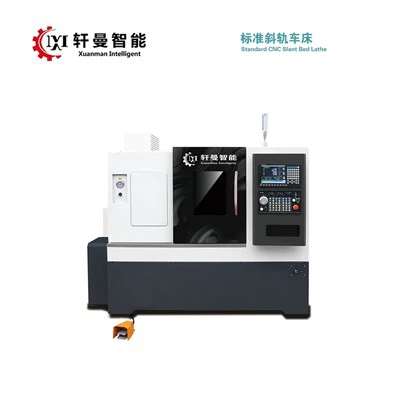
Slant Bed Lathe Selecting the right cutting tools for a five – axis machining center when machining different materials is a complex but crucial task. By considering factors such as material hardness, cutting speed and feed rate, tool geometry, and coating, you can make informed decisions and choose the most appropriate cutting tools for your machining needs. As a supplier of five – axis machining centers, we are committed to providing our customers with the best solutions and support. If you are interested in learning more about our products or have any questions regarding cutting tool selection, please feel free to contact us for a procurement discussion.
References
- "Machining Technology: An Introduction" by David A. Dornfeld
- "Cutting Tool Technology" by Paul D. Kovach
- "Handbook of Machining with Cutting Tools" by I. S. Jawahir
Jiangsu Xuanman Intelligent Equipment Co., Ltd.
We’re well-known as one of the leading five-axis machining center manufacturers in China, featured by quality products and low price. Please rest assured to buy discount five-axis machining center made in China here from our factory. We also accept customized orders.
Address: No. 1-1, Weier Road, Jieji Equipment Manufacturing Industrial Park, Sihong County, Suqian City, Jiangsu Province, China
E-mail: jsxmzn@163.com
WebSite: https://www.xm-cnc.com/
