If you’ve ever worked with air moving equipment in mountainous regions or high-altitude industrial hubs like Denver, Albuquerque, or La Paz, you’ve probably noticed that standard blowers don’t perform the way they do at sea level. As a supplier of double stage regenerative blowers, I’ve spent the last 12 years troubleshooting performance issues for customers across varying elevations, and the one question I get asked most often is: how exactly does altitude change the way these machines work? The short answer is that altitude isn’t just a matter of higher elevations—it’s a direct shift in the air density that these blowers rely on to function. Let’s break this down in plain, practical terms, no overly complex jargon, and share what we’ve learned from real-world customer projects. Double Stage Regenerative Blowers
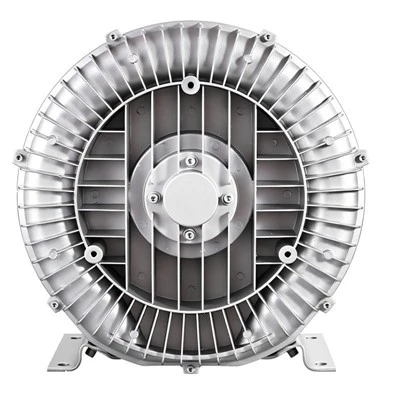
First, let’s recap what a double stage regenerative blower is, for anyone new to this space. Unlike single stage blowers that compress air in one pass through the impeller, double stage models push air through two separate impeller chambers, one after the other, to generate higher pressure and airflow than their single stage counterparts. We sell these blowers for applications ranging from wastewater aeration and pneumatic conveying to aquarium systems and industrial dust extraction—anywhere you need consistent, controlled airflow at a steady pressure. At sea level, where atmospheric pressure is roughly 14.7 PSI (pounds per square inch), these blowers are sized and calibrated to move a specific volume of air at a given pressure. But at higher altitudes, atmospheric pressure drops: for every 1,000 feet above sea level, atmospheric pressure decreases by about 0.5 PSI. At 5,000 feet, that’s 12.2 PSI; at 10,000 feet, it’s 10.1 PSI. That 2-4 PSI gap might sound small, but it makes a huge difference in how your blower performs.
Let’s start with the biggest impact: airflow rate. Airflow (measured in CFM, or cubic feet per minute) is the volume of air a blower moves in a given time. Regenerative blowers work by trapping air in the gaps between the impeller blades and the blower housing, spinning that air to build up momentum, and pushing it out. The amount of air a single impeller can handle depends on how dense that air is. At higher altitudes, air is less dense—there are fewer air molecules per cubic foot. So even if your blower is spinning at the same RPM (rotations per minute) as it does at sea level, it’s moving fewer actual air molecules. A customer of ours in Boulder, Colorado (5,430 feet above sea level) bought two of our standard double stage regenerative blowers last year for a wastewater aeration project, and within a month they were calling us frustrated: the aeration tanks weren’t getting enough oxygen, and their treatment process was slowing down. We checked the blower specs against their elevation, and it turns out the standard CFM rating we provided was for sea level. At 5,430 feet, that same blower was only moving 82% of its rated CFM—right in line with the standard density correction factor for altitude. The fix? We re-calibrated their blowers to account for the lower air density, and we suggested a slight increase in motor RPM, which is safe as long as it doesn’t overwork the motor. After that adjustment, their aeration levels went back to exactly what they needed.
Next up: pressure performance. Double stage regenerative blowers are valued for their ability to deliver consistent static pressure, which is the force needed to push air through pipes, filters, or other obstructions. Pressure is measured in inches of water gauge (in. wg) for low-pressure applications, which most regenerative blowers handle. At sea level, a double stage blower might be rated for 200 in. wg of pressure, but at 5,000 feet, that same blower can only produce about 165 in. wg of actual pressure. Why? Because pressure generated by a blower is proportional to the density of the air it’s moving. Think of it like pushing a full shopping cart versus an empty one: the full cart (denser air) gives more resistance, so the blower has to work harder to build pressure. When air is less dense, there’s less resistance, so the blower can’t build as much pressure even if it’s running at full speed. One of our key customers in Albuquerque (5,312 feet) uses double stage blowers for pneumatic conveying of plastic pellets. They initially ordered our standard 150 in. wg blowers, and they were only getting 125 in. wg at their elevation—enough to move pellets, but they were experiencing frequent clogs in their 100-foot conveying line. We worked with their engineering team to select a larger double stage blower, sized using our altitude correction formula, which accounts for both elevation and the specific pressure they needed. The new blower delivered 152 in. wg at their elevation, eliminating clogs and cutting their maintenance time by 30% within three months.
Another area where altitude hits hard is motor load and energy efficiency. Since less dense air means a blower has to spin faster or move more volume to get the same work done, that translates to higher electrical load on the motor. At higher altitudes, our blowers will draw between 5-15% more amps than they do at sea level, depending on elevation. That’s not just an inconvenience—it can lead to higher utility bills, and if your motor isn’t sized correctly for the extra load, it can overheat and fail prematurely. We had a customer in Flagstaff, Arizona (7,000 feet) who installed three standard double stage blowers for dust extraction in their woodworking shop. Within six months, two of the motors burned out. When our service tech arrived, he tested the motor load: each was drawing 12% more amps than the sea level rating. The shop owner had sized the blowers based on sea level specs, not accounting for the extra motor load at altitude. We upgraded their motors to high-altitude-rated models, which are designed to handle the extra electrical demand, and also adjusted the blower impeller trim slightly to reduce the load. The new motors have lasted 18 months now, with no issues, and their energy usage is actually more efficient than before, because the trim adjustment ensures they’re not working harder than necessary.
Wait, but is there any upside to altitude for double stage regenerative blowers? Believe it or not, in some specific cases, yes. For applications that require very high airflow and lower pressure, higher altitude can actually be beneficial. Because the air is less dense, the blower has to move less mass to get the same volume of air, which can reduce wear on the impeller and blower housing over time. We have a customer in Leadville, Colorado (9,900 feet, the highest incorporated city in the U.S.) who uses our double stage blowers for air sampling in a scientific research lab. They don’t need high pressure—just a steady, high volume of air. The standard blowers we provided there work better for their application than they would at sea level, because they don’t have to build as much pressure, so they run cooler and last longer. But this is a niche case; for most industrial applications that rely on consistent pressure, altitude is a net negative that requires adjustment.
Now, let’s talk about how we, as a supplier, approach this. We don’t just sell a blower and hope it works—we’ve built altitude correction into our entire quoting process. For any customer operating above 2,000 feet, we ask for two key numbers: their exact elevation, and the required airflow and pressure for their application. We use a standard density altitude formula to adjust the blower’s rating, but we also do on-site testing when possible, because every application is different. We’ve found that many customers don’t realize that blower ratings are standardized for sea level, so we make a point to explain that upfront, no fine print. We also offer high-altitude-rated blowers that are pre-configured for elevations up to 10,000 feet, with adjusted motor sizing and impeller design, which saves customers the hassle of figuring out the math themselves.
We also work with our customers to monitor blower performance after installation. One common mistake people make is assuming that if their blower is running, it’s performing correctly. But at altitude, small adjustments can make a big difference. We encourage customers to track airflow, pressure, and motor load, and we offer remote support to troubleshoot any issues that come up. Last year, a customer in Casper, Wyoming (5,142 feet) had a blower that was underperforming for their grain drying application. We logged into their blower’s monitoring system remotely and adjusted the motor speed by 5 RPM, which was enough to get their airflow back to the required level, no parts replacement needed. That’s the kind of support that makes all the difference, especially when you’re working at elevation and troubleshooting can be harder because of limited access to parts or service techs.
So what’s the bottom line for anyone using double stage regenerative blowers at altitude? First, don’t rely on sea level blower ratings—they’re not accurate for elevations above 2,000 feet. Second, work with a supplier that understands the unique challenges of altitude, not just someone who sells blowers without considering elevation. Third, size your blower for both your application needs and your specific elevation to avoid underperformance, overloading, or premature motor failure. At the end of the day, a double stage regenerative blower is a long-term investment—we’ve had customers using our blowers for 10+ years, but only if they’re sized correctly for their operating conditions.

If you’re working with double stage regenerative blowers at altitude, whether you’re in a mountain city, a high desert industrial park, or a remote mine site, and you’re seeing underperformance, clogs, or higher energy bills, we’re here to help. We don’t use one-size-fits-all solutions—we work with you to adjust your blower setup to match your exact elevation and application needs. Reach out to our team to discuss your project, and we’ll help you find the right double stage regenerative blower for your altitude, no guesswork included.
Pedestal Axial Fans References
- Gas Processors Suppliers Association. (2012). GPSA Engineering Data Book, 13th ed. Tulsa, OK: Gas Processors Suppliers Association.
- Blachford, J., & Turner, R. (2018). Air Density Correction Factors for Rotating Equipment Performance. Journal of Industrial Fluid Machinery, 126(4), 212-219.
- Hydraulic Institute. (2020). Standards for Positive Displacement Blowers, 3rd ed. Parsippany, NJ: Hydraulic Institute.
- U.S. Department of Energy. (2019). High-Altitude Motor Performance Guidelines for Industrial Equipment. Washington, DC: U.S. Department of Energy, Office of Energy Efficiency and Renewable Energy.
Taizhou Yijia Electromechanical Co., Ltd.
As one of the most professional double stage regenerative blowers manufacturers and suppliers in China, we also support customized service. Please rest assured to buy high quality double stage regenerative blowers in stock here from our factory. If you have any enquiry about cooperation, please feel free to email us.
Address: No. 47, Jinxing First District, Jintang Village, Jinqing Town, Luqiao District, Taizhou City, Zhejiang Province
E-mail: 826339968@qq.com
WebSite: https://www.yijiablower.com/
